A Mother’s Story
“Can you just see if these are the right size? You know, like you used to – press down on my toe.”
“Ow! Not that hard!”
My 27-year-old son was preparing to leave for Australia. Talk of the
UK’s energy crisis and rising fuel bills meant little to someone heading for sunnier skies.
“You can have these,” he said, tossing a tangle of thermal clothing onto my bed. He’d noticed I’d been wearing one of his old padded shirts, left draped over the bannister. I told him I kept it there so I could touch it every time I went upstairs. He rolled his eyes. Soft, warm, familiar. That shirt had once been a goalpost, and worn on a chaotic night walk with my father through a field of cattle, which according to my sons, ended in a minor stampede. One piece of clothing, so many memories; connecting us to people we love and the lives we’ve shared.
His journey to the land down under was driven by a quiet but growing fear that he might be losing his love for medicine. The transition from the protective environment of medical school to the unrelenting demands of the pandemic had been brutal. In three months, he’d certified more deaths than most junior doctors would expect in three years. It was the grounding presence of senior colleagues that helped reframe his experience, helping him see that learning to recognise the signs of death was not a failing, but a crucial part of the reason he went into medicine in the first place: to support life. As parents, we don’t own our children. We bring them into being, introduce them to the world and the world to them. We guide, protect, walk alongside, and light the path until they’re ready to f ind their own.
Then in February, a phone call came.
“There’s no easy way to say this — James is dead.”
James was his best friend. He had recently moved overseas to begin a teaching job.
“I spoke to him just a couple of weeks ago… but it wasn’t for long.”
His voice trailed off. Shock, disbelief, grief, regret, all fused together. Thousands of miles from home, from his friends, from the places he’d shared with James, my son was cast adrift. There
was no ground beneath his feet. No harbour. No familiar shore. Just the raw force of emotion — unpredictable, overwhelming. Later, it became known that James had likely taken his own life. The pain of that truth is beyond description. It brought a new level of grief — deeper questions, impossible to answer. My son’s sorrow, so far away, met my own here at home. A new kind of ache. From the day my children were born, I’ve respected their independence and individuality. I’d always tried not to overstep, not to reach too far into their lives. But this was different. This was uncharted territory.
From across the world, my son chose some flowers and words for a card. I would deliver them in person to James’s family. Though I had visited many families facing crisis in my years as a clinical psychologist, this journey was different. I was going as a mother, without professional distance. And oddly, I lost my bearings, circling the area, unsure of the way. Eventually, I parked and walked. Feeling the ground beneath my feet helped connect me to my purpose.
James’s dad greeted me with a warm smile and a strong hug, allowing me to fully exhale and let go of the fear I had been carrying with the card and the flowers. Inside, I sat on the floor beside Spencer, their beloved golden retriever, who offered quiet comfort to every visitor. The family huddled together, as if sheltering physically and emotionally from a storm.
There were flowers everywhere. Beautiful, fragrant, heartbreaking. James’s mum whispered words from the cards that had arrived, careful not to upset his dad. I had only ever spoken to them in passing – the occasional chat after football or social events. And yet they welcomed me in, made tea, and shared a space of profound sorrow. There was no need to explain or fill the silence. Just being together was enough.
I didn’t set out to grow sunflowers. I had no plan, no long-held dream. I didn’t even know how. But in the face of helplessness, I needed to do something. It was visceral. Heart-led. An act of resistance against the pain of a life ended too soon.
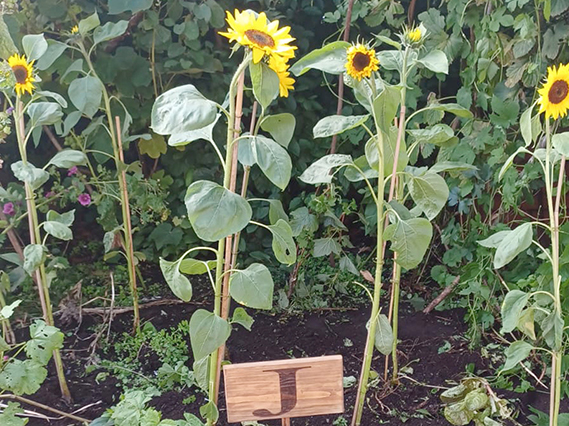
Soon, my kitchen table was covered in plant pots, carefully balanced on trays of all shapes and sizes. Every day, I watered them and marveled at each tiny green shoot emerging from the soil. I faced my ignorance on a regular basis, making many mistakes by planting them too closely and not deeply enough, and being unconventional in my approach; staking them with cocktail sticks and wool. Friends came to tactfully advise. I planted more. And more. By summer, the backyard was filled with 35 proud, tall sunflowers.
When my son came home in July for a few weeks, we surprised him with a gathering of his closest friends. The exhaustion from the long flight was soon forgotten when his friends sprung out on
him. The house filled with the all too familiar level of noise and laughter, a torrent of boy energy, the beautiful chaos of old friends reconnecting. But beneath the joy, there was something else: a shared understanding that their lives had changed by what had been lost. That youth was not invincible. That James wasn’t there.
I showed them the proudly swaying sunflowers and explained why I had grown them.
“I just didn’t know what else to do,” I said. “But maybe, now that they are here, we could do something together, something for James”.
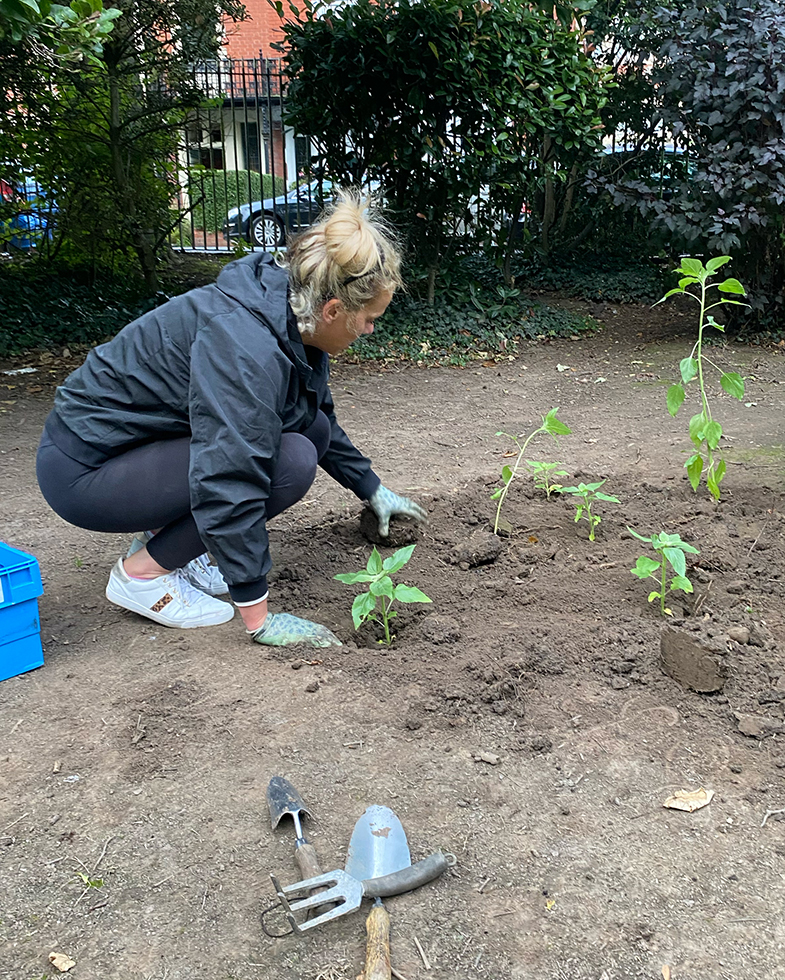
We identified places that they associated with James: Chapter Arts Centre, Victoria Park, the Buddhist Centre. My son spoke to James’s parents, and together, groups of friends and family came to plant the flowers in these meaningful places. I hadn’t known James well. Just glimpses – a wave at the door, a lift after football. But I discovered so much about him and what he meant to others through the planting of those seeds. Many stories were shared as the sunflowers were planted out. I came to know the depth of who he was to those around him: funny, loving, sensitive, bold, inspiring, flawed, unforgettable. A true force of nature.
Postscript
Sunflowers have come to mean many things to many people, across cultures and throughout time. For me, growing sunflowers gave me a sense of quiet strength, of doing something, however small, in the face of helplessness. Planting out the flowers with James’s friends and family became a way to move through grief, to honour memory. They were – and are – symbols of connection, growth, and the resilience of love.